
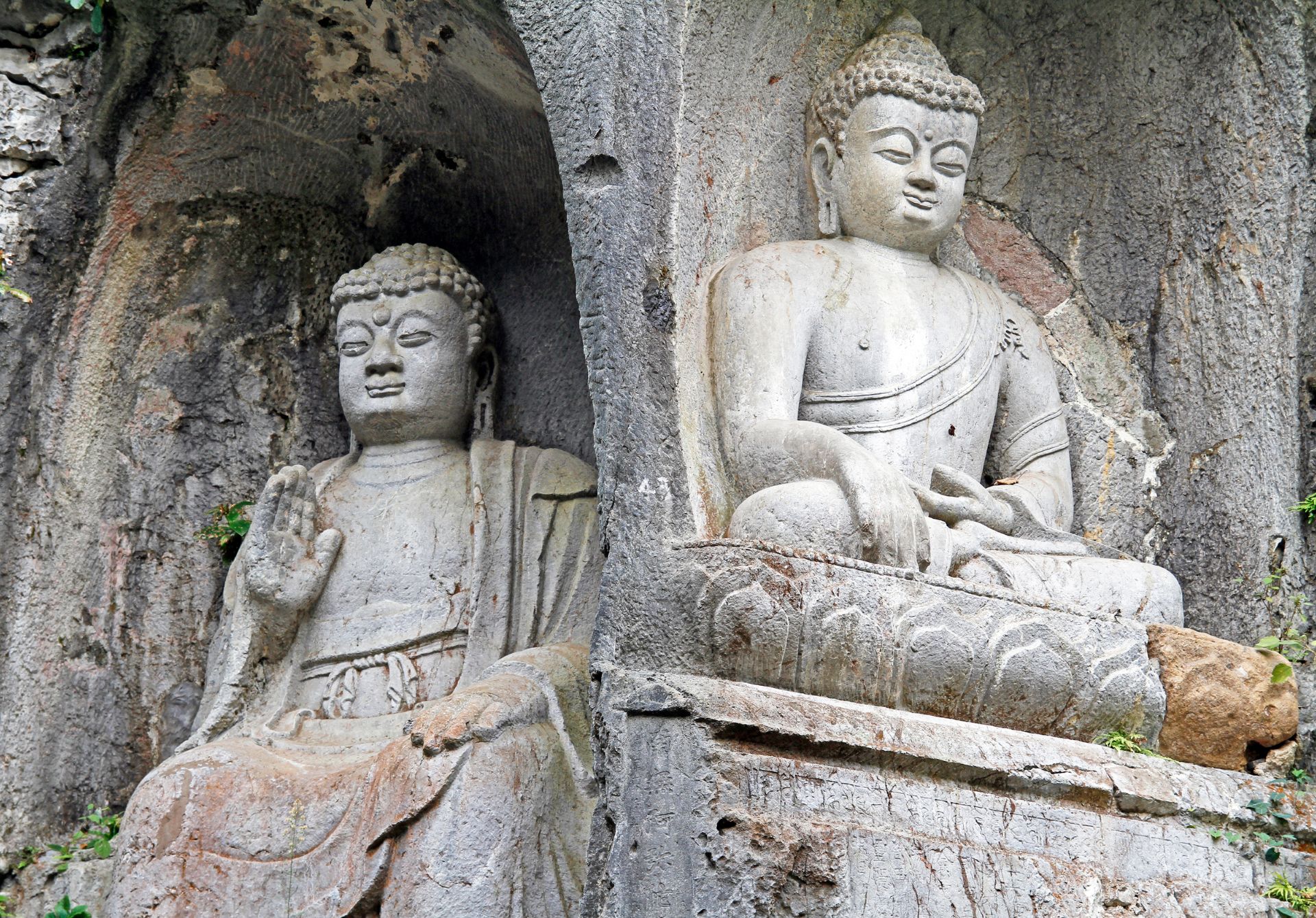
Picture this: you’re wandering through moss-covered limestone cliffs, ancient Buddha statues carved into every crevice, with the sound of a gentle stream echoing through caves that have witnessed over a thousand years of devotion. Welcome to Feilai Feng Grottoes, one of Hangzhou’s most spectacular and spiritually rich destinations that deserves a prime spot on your China itinerary.
The Peak That “Flew” From India
Let’s start with the name itself, because trust me, there’s a story here. Feilai Feng translates to “Peak Flown From Afar,” and according to legend, an Indian monk named Huili arrived in this valley around 1,600 years ago during the Eastern Jin Dynasty. When he saw this 209-meter limestone peak jutting out among the sandstone mountains, he was convinced it had literally flown overnight from his homeland in India. Why? Because its craggy, distinctive appearance looked nothing like the surrounding Wulin Mountains but remarkably similar to peaks back home. Whether or not you believe a mountain can fly, you’ll definitely agree there’s something otherworldly about this place.
There’s also a more charming local legend involving the famous Monk Ji Gong, who supposedly predicted the peak’s arrival and saved an entire village by tricking people into fleeing—including dramatically carrying off a bride during her wedding ceremony. The peak landed right where the village had been, and Ji Gong became a local hero. These stories add layers of mystique that make your visit feel less like sightseeing and more like stepping into living folklore.
A Living Museum of Buddhist Art
Here’s what makes Feilai Feng truly extraordinary: it houses approximately 470 Buddhist stone carvings scattered across its cliffs, caves, and riverbanks. Even more impressive? Around 335 of these carvings are remarkably well-preserved, with the earliest dating back to 951 AD. That’s over 1,000 years of artistry waiting to greet you.
These aren’t just random sculptures—they represent the evolution of Chinese Buddhist art across multiple dynasties. You’ll find carvings from the Tang Dynasty, Five Dynasties period, Northern Song Dynasty, and Yuan Dynasty, each reflecting the artistic sensibilities and spiritual practices of their time. The Yuan Dynasty carvings particularly stand out because they blend traditional Tang and Song styles with influences from Tibetan and Mongolian art, creating something truly unique.
The site is often considered the most significant collection of Buddhist rock carvings in Southern China, ranking alongside legendary sites like Dunhuang Mogao Grottoes and Luoyang Longmen Grottoes. For concierge professionals arranging VIP cultural experiences, this is exactly the kind of authentic, under-the-radar gem that sophisticated travelers crave.
Must-See Caves and Highlights
When you arrive, you might feel overwhelmed by the number of paths winding between limestone hills. Let me break down the can’t-miss spots:
- Qinglin Cave: This cave houses “The Three Saints of the West,” carved in 951 AD—the very earliest Buddhist carving at Feilai Feng. It features Buddha Amituofo flanked by Bodhisattvas Guanyin and Dashizhi from Pure Land Buddhism.
- Yuru Cave (Cave of Jade Milk): Named for the milk-like limestone drippings from its ceiling, this 270-square-meter cave contains a group of arhats and relief carvings. At the eastern entrance, you’ll find 6 niches containing 39 statues.
- Longhong Cave: Also called “Cave Leading to the Sky,” this grotto features a seated statue of Avalokitesvara. In the neighboring Shenxu Cave, visitors can experience the famous “thread of sky” view through rock tunnels above.
- The Laughing Buddha: Perhaps the most photographed carving at the site—this jolly figure sits along the stream with his exposed belly and chest. According to tradition, his large belly holds all the world’s troubles. This particular shrine stands an impressive 3.6 meters high and 9.9 meters long, making it the largest shrine on the entire peak.
Practical Information for Your Visit
Entry Fees and Tickets:
- Feilai Feng Scenic Area: ¥45 RMB
- Lingyin Temple: ¥30-35 RMB (separate ticket)
- Combo ticket available: ¥75 RMB
Opening Hours: 7:00 AM – 6:00 PM (some sources indicate 7:30 AM – 5:00 PM)
Note the two-stage ticketing system: you’ll purchase tickets to enter the Feilai Feng Scenic Area first, then if you wish to visit the adjacent Lingyin Temple, you’ll need an additional ticket. Many visitors find the combo ticket offers good value since the sites complement each other beautifully.
Getting There: Transportation Tips
Feilai Feng is located approximately 3.5 kilometers west of West Lake’s western banks in Hangzhou’s Lingyin Scenic Area. Here are your best options:
- By Bus: Multiple routes service the area including Y1, Y2, K7, K807, K837, J17, and J18. Get off at Lingyin (Feilai Feng) station. This is the most stress-free option according to recent travelers.
- By Metro + Transfer: Take the Hangzhou Metro to Lingyin Station, then catch a short bus or taxi ride to the scenic area entrance.
- By Taxi/Ride-Share: A 20-40 minute ride from most locations around West Lake, depending on traffic. Pro tip: have your hotel arrange the taxi and confirm the exact drop-off point with the driver to avoid confusion.
Weekend traffic can be heavy, so plan accordingly. Arriving early morning not only helps you beat the crowds but also gives you that magical golden-hour lighting for photography.
Planning Your Time
Budget at least 3-4 hours to properly explore both Feilai Feng Grottoes and Lingyin Temple at a comfortable pace. The terrain includes stairs, uneven surfaces, and narrow paths winding through caves—wear comfortable walking shoes. While there’s signage throughout the site, hiring a guide significantly enhances the experience by providing historical context and helping you understand the significance of different carvings.
The best time to visit is March through May when spring blossoms frame the scenic area in spectacular color. However, this also means larger crowds, so consider visiting on weekdays if your schedule allows.
The Lingyin Temple Connection
Don’t leave without visiting Lingyin Temple, founded by the same monk (Huili) who supposedly “discovered” the flying peak. This massive Chan Buddhist temple dates to 328 AD and ranks among China’s largest and wealthiest monasteries. At its height during the Wuyue Kingdom (907-978 AD), the temple complex boasted 18 pavilions, 72 halls, over 1,300 rooms, and housed more than 3,000 monks.
Today, it remains an active place of worship where you can observe locals burning incense and offering prayers. The temple survived the Cultural Revolution thanks to protection from Premier Zhou Enlai and continues to thrive as both a pilgrimage site and tourist destination. Even former paramount leader Deng Xiaoping was a regular pilgrim here.
Insider Tips for Concierge Services
- The area just after ticket check features a quiet park with large Chinese drums surrounded by hydrangea bushes—a perfect spot for guests to pause before the main attraction.
- Lengquan Stream runs alongside the peak, and the water-eroded caves here have inspired countless local legends. The gentle sound of flowing water adds to the meditative atmosphere.
- For photography enthusiasts, early morning or late afternoon provides the best lighting to capture the texture and details of the carvings.
- Accessibility varies throughout the site. Elderly guests or those with mobility concerns should be advised about stairs and uneven ground in certain areas.
- On-site ticket purchases are available, but buying in advance can save time during busy periods.
Why This Matters for Your Clients
In an era of over-touristed landmarks, Feilai Feng Grottoes offers something increasingly rare: authentic cultural immersion without overwhelming commercialization. Yes, it gets crowded on weekends, but the sheer scale of the site means there are always quiet corners to discover. Your clients won’t just be checking off another UNESCO-adjacent site—they’ll be walking through living history, touching the same stone paths that monks traversed a millennium ago, and experiencing Buddhist art in its natural context rather than behind museum glass.
The combination of natural beauty (limestone formations, ancient trees, flowing streams), spiritual significance (an active religious site), and artistic masterpieces (those 470+ carvings) creates a multi-layered experience that appeals to diverse interests. Whether your clients are culture vultures, spiritual seekers, photography enthusiasts, or simply curious travelers, Feilai Feng delivers.
Final Thoughts
The famous Song Dynasty poet Su Dongpo once wrote: “One loves the scenery of the Peak Flown from Afar of the Lingyin Temple best, though beautiful landscape is everywhere.” Nearly a thousand years later, his words still ring true. Feilai Feng Grottoes represents the best of what Chinese cultural tourism should be—deeply historical, naturally beautiful, spiritually resonant, and surprisingly accessible.
For concierge professionals and tourism operators, this is the kind of destination that transforms a good China itinerary into an unforgettable journey. It’s not just about seeing ancient Buddha statues; it’s about understanding how art, faith, and legend intertwine in the Chinese cultural imagination. And when your clients stand before that Laughing Buddha, his carved belly holding the world’s troubles, they’ll understand why some experiences are worth the journey to discover.